Tuesday, January 12, 2010

Marcus Garvey

Fact Sheet on Marcus Garvey


Full Name: Marcus Mosiah Garvey, Jr.

Parents: Malcus ("Marcus") Mosiah Garvey, a mason & Sarah Jane Richards, a domestic servant and produce grower

Born: 17 August 1887, at St. Ann's Bay, north coast of Jamaica

Died: 10 June 1940, London, England

Buried: Marcus Garvey Memorial, National Heroes' Park, Kingston, Jamaica

Citizenship: British colonial subject / Applied for American citizenship in 1921

Education: Standard 6, Church of England school, Jamaica, audited courses, Birkbeck College, London, 1914

Employment: Printer, Journalist & Publisher

Marriages:

Amy Ashwood (1897--1969), co-founder of the UNIA in Jamaica, journalist, feminist, playwright, business manager of UNIA offices in Harlem, 1919 (married to Garvey 1919--1922)

Amy Jacques (1896--1973), legal assistant in Jamaica before migrating to U.S., where she became business manager and personal secretary to Garvey in 1920, associate editor of the Negro World 1924--1927, and Garvey's unofficial representative during his incarceration in 1925--1927, becomes main propagandist of the Garvey movement with Philosophy and Opinions, published in 2 volumes, 1923, 1925 (married to Garvey 1922--1940)

Children: Marcus Garvey Jr. (1931--), Julius Winston Garvey (1933--) both by Amy Jacques; both born in Jamaica, now U.S. residents

Countries of residence:

Jamaica, 1887--1910

Panama, 1910

Costa Rica, 1911

Jamaica, 1912

England, 1912--1914

Jamaica, 1914--1916

United States, 1916--1927

Jamaica, 1927--1935

United Kingdom, 1935--1940

Universal Negro Improvement Association (UNIA) Career:

founds UNIA in Jamaica, July 1914

forms branch in New York City, May 1916 (January 1918?)

incorporates movement in New York state, June 1918

starts Negro World newspaper, August 1918

starts Black Star Line shipping company, 1919

starts Negro Factories Corp., 1920

announces Liberian Colonization Plan, 1920

sends first delegation to Monrovia, Liberia, 1921

makes organizational tour of Caribbean and Central America, 1921

arrested and indicted on Mail Fraud Charges, 1922

meets with Acting Imperial Wizard of the Ku Klux Klan, causing backlash of opposition from other black leaders, 1922

second UNIA delegation sent to Liberia, 1923

starts Black Cross Navigation and Trading Co. to replace defunct Black Star Line;

UNIA purchases Smallwood-Corey School ("Liberty University") in Claremont, Virginia

tours Europe, 1928

becomes proprietor of Edelweiss Park, a social center for blacks in Kingston

tries to establish political career in Jamaica

begins publishing the Blackman, 1929

begins publishing the New Jamaican

begins publishing the Black Man, 1933

bankrupt, announces move to London, 1934

teaches School of African Philosophy to UNIA leaders in Toronto, 1937

cerebral hemorrhage, January 1940

dies 10 June 1940

James Stewart elected UNIA president, August 1940

headquarters of UNIA moved to Cleveland, Ohio

Mail Fraud Trial:

Begins May 1923

convicted June 1923

appeal denied February 1925

Imprisonment:

February 1925--November 1927, federal penitentiary, Atlanta, Georgia

Deportation:

December 1927
 
Bio:
 
Marcus Garvey, a black man from the West Indies, was the first to forcefully speak about the concept of African nationalism—of black people returning to Africa, the continent of their forefathers, in order to build a great nation of their own. His writings and ideas would inspire many leaders of the civil rights movement during the second half of the twentieth century.


Early life

Marcus Mosiah Garvey was born in St. Ann's Bay, Jamaica, on August 17, 1887, the youngest child of a stonemason (one who prepares stones for building). He went to the local elementary school, and at the age of fourteen became an apprentice (working to gain experience) in the printing trade. In 1903 he went to the capital, Kingston, to work as a printer. He soon became involved in public activities and helped form the Printers Union, the first trade union in Jamaica. In 1907 he took part in the unsuccessful printers strike, where organized workers refused to work unless certain demands were met. This experience influenced the young Garvey in both his political and journalistic passions. He soon began publishing a periodical called the Watchman.

In 1910 Garvey began a series of travels that transformed him from an average person concerned about the problems of those with less opportunity, to an African nationalist determined to lift an entire race from bondage. He visited Costa Rica, Panama, and Ecuador, and worked as an editor for several radical newspapers. After briefly returning home, he proceeded to England, where contacts with African nationalists stimulated in him a keen interest in Africa and in black history. In each country he visited, he noted that the black man was in an inferior position, subject to the ever-changing ideals of stronger races. His reading of Booker T. Washington's (1856–1915) "Up from Slavery" at this time had a great effect upon him. Also at this time Garvey met Duse Mohammed Ali, a Sudanese-Egyptian and strong supporter of African self-rule. Garvey began writing for Ali's small magazines and was introduced to other black activists.

On his return to Jamaica in 1914 from England, Garvey formed the Universal Negro Improvement Association and African Communities League (UNIA-ACL). These organizations were intended "to work for the general uplift of the Negro peoples of the world," and would become the centerpiece for his life's work.

Message in America

In 1916 Garvey went to the United States to raise funds to carry on the work of his Jamaican organizations. He was immediately caught up in the unrest of the times, and his voice thundered in the evenings on the streets of Harlem in New York City, New York. A New York branch of the UNIA was established, soon followed by branches in

other cities in the United States, in Central and South America, and in the Caribbean. The expansion of the UNIA was publicized by its official voice, Negro World, a newspaper published in English, Spanish, and French. Published in New York City from 1918 to 1933, the magazine was succeeded by the monthly Black Man, which ran through the 1930s, published after 1934 in London.

Negro World reached out to black communities all over the world. It even penetrated into the interior of Africa, even though the white rulers there had banned it. Garvey stressed the need for blacks to return to Africa for the building of a great nation, but he realized that until this was accomplished, Africans needed to make themselves economically independent wherever they lived. He encouraged black people to start their own businesses—to take the business of their ghettos into their own hands.

Together with the American clergyman Archbishop George A. McGuire (1866–1934), Garvey formed the African Orthodox Church. This was in accordance with one of his basic principles, for he believed that each race must see God through its own racial eyes. The Black Christ and the Black Madonna were officially announced at the UNIA convention of 1924.


The Movement Stumbles


The Black Star Line shipping company and the Negro Factories Corporation were to be the commercial strengths of the Garvey movement. But it was the failure of the shipping venture that gave Garvey's enemies the opportunity to destroy him. Investments in the shipping line were lost, and in 1925 Garvey was imprisoned in the United States. After serving two years and ten months of a five-year sentence, he was deported, or forced out of the country, to Jamaica.

Previously, his plans for colonization in Liberia had been ruined by the colonial powers that brought pressure to bear on the Liberian government. As a result, the land that had been granted to the Garvey organization for the settlement of overseas Africans was given to the white American industrialist Harvey Firestone (1863–1938). And the expensive equipment shipped to Liberia for the use of Garvey's colonists was seized.

In Jamaica, Garvey attempted to enter local politics, but restrictions at the time did not allow the vote to the black masses. He went to England and continued his work of social protest and his call for the liberation (freeing) of Africa. He died in London on June 10, 1940. Marcus Garvey was married twice. His second wife, Amy Jacques, whom he married in 1922, bore him two sons
Garvey's legacy


The Garvey movement was the greatest international movement of African peoples in modern times. At its peak, from 1922 to 1924, the movement counted more than eight million followers. The youngest members of the movement were taken in at five years of age and, as they grew older, they graduated to the sections for older children.

Garvey emphasized the belief in the One God, the God of Africa, who should be visualized through black eyes. He preached to black people to become familiar with their ancient history and their rich cultural heritage. He called for pride in the black race—for example, he made black dolls for black children. His was the first voice to clearly demand black power. It was he who said, "A race without authority and power is a race without respect."

In emphasizing the need to have separate black institutions under black leadership, Garvey anticipated the mood and thinking of the future black nationalists by nearly fifty years. He died, as he lived, an unbending leader of African nationalism. The symbols which he made famous, the black star of Africa and the red, black, and green flag of African liberation, continued to inspire younger generations of African nationalists.

For More Information

Cronon, E. David. Black Moses: The Story of Marcus Garvey and the Universal Negro Improvement Association. Madison: University of Wisconsin Press, 1955.

Lewis, Rupert, and Maureen Warner-Lewis. Garvey: Africa, Europe, the Americas. Kingston, Jamaica: Institute of Social and Economic Research, University of the West Indies, 1986.

Lewis, Rupert. Marcus Garvey: Anti-Colonial Chamption. Trenton, NJ: Africa World Press, 1988.

Robinson, Wilhelmena S. Historical Negro Biographies. New York: Publishers Co., 1967.

Monday, January 11, 2010

BLACK HISTORY BOOKS PACK

Lemme drop this... I got some more. Enjoy brothers and sisters!

BLACK HISTORY BOOKS PACK 1

African Origins of World Religions
Bantu Origins (People & Language) - A.T. Bryant
Cheikh Anta Diop - Civilization of Barbarism
Cheikh Anta Diop - Cultural Unity of Black Africa
Cheikh Anta Diop - Precolonial Black Africa
Cheikh Anta Diop -The African Origin of Civilization
Julian Baldick - Black God
Wonderful Ethiopians 1926 Book
The World's Sixteen Crucified Saviors - Kersey Graves
the kebra negast
The Two Babylons
& more
(311.07 MB)

http://www.megaupload.com/?d=FM9NKGBP

Some of the books have to be viewed thru CDisplay. It is included. Hotep!

BLACK HISTORY BOOKS PACK 2

Chancellor Williams - Destruction of Black Civilization
Ivan Van Sertima - Early America Revisited
Ivan Van Sertima - They Came Before Columbus
J A Rogers - World's Great Men Of Color Vol.1
J A Rogers - World's Great Men Of Color Vol.2
Rudolph R Windsor - From Babylon 2 Timbuktu
The Truth About Black People And Their Place In World History
& a few more things
(300.54 MB)

http://www.megaupload.com/?d=8PEIEIAT

Wednesday, January 6, 2010

Dr. Cheik Anta Diop

Afrikan Origins of Humanity & Civilization
               

Tuesday, January 5, 2010


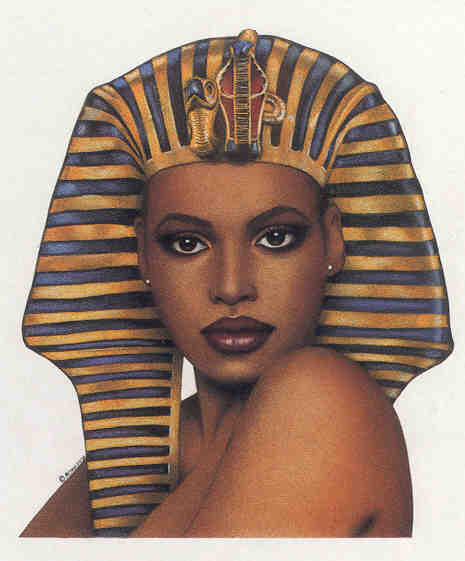
Hatshepsut
QUEEN OF KEMET (Ancient Egypt the land of the blacks) (1503-1482 B.C.)

One of the greatest queens of ancient Kemet was Queen Hatshepsut. While she was known as a "warrior" queen, her battles were engaged with her own rivals for the position of power in Kemetic hierarchy. A born dynast in her own right, Hatshepsut proved to be an aggressive and overpowering force. However, it was not in war, but in her aspiration to ascend to the "Heru (Horus) consciousness," she displayed the strength that has given her a place in history.

She adopted the Truth of Maat and became involved in the elimination of undesirable people and elements from Kemet. Determined to be revered in times yet to come, Hatshepsut depicted herself in as many masculine attributes as possible, i.e. male attire, king’s beard, etc. Although she ascended to the throne upon the death of her king-brother Thutmose II, she exerted her rightful claim to the throne. In exercising her power, she involved herself in foreign campaigns, a concentration on domestic affairs, extensive building and commercial ventures.

Even before becoming legal ruler, Hatshepsut, was actively pushing things dearest to the hearts of all Africans leaders: the expansion of foreign trade, international diplomatic relations, perfection of national defense, vast public building programs, securing the South and the North through either peace or war and, one of her "pet projects", building a great navy for both commerce and war.

Hatshepsut reestablished the trade networks that had been disrupted during the Hyksos occupation of Egypt during the Second Intermediate Period, thereby building a wealth of the eighteenth dynasty that has become so famous since the discovery of the burial of one of her descendants, Tutankhamun, began to be analyzed.

She oversaw the preparations and funding for a mission to the Land of Punt. The expedition set out in her name with five ships, each measuring 70 feet (21 m) long bearing several sails and accommodating 210 men that included sailors and 30 rowers. Many trade goods were bought in Punt, notably myrrh, which is said to have been Hatshepsut's favorite fragrance.


Most notably, however, the Egyptians returned from the voyage bearing 31 live frankincense trees, the roots of which were carefully kept in baskets for the duration of the voyage. This was the first recorded attempt to transplant foreign trees. It is reported that Hatshepsut had these trees planted in the courts of her Deir el Bahari mortuary temple complex. Egyptians also returned with living Puntites (people of Punt). This trading expedition to Punt was roughly during Hatshepsut's nineteenth year of reign.


She had the expedition commemorated in relief at Deir el-Bahri, which also is famous for its realistic depiction of the Queen of the Land of Punt, Queen Iti, who appears to have had a genetic trait called steatopygia. Hatshepsut also sent raiding expeditions to Byblos and Sinai shortly after the Punt expedition. Very little is known about these expeditions. Although many Egyptologists have claimed that her foreign policy was mainly peaceful,[18] there is evidence that Hatshepsut led successful military campaigns in Nubia, the Levant, and Syria early in her career.Hatshepsut was one of the most prolific builders in ancient Egypt, commissioning hundreds of construction projects throughout both Upper and Lower Egypt, that were grander and more numerous than those of any of her Middle Kingdom predecessors.

She employed two great architects: Ineni, who also had worked for her husband and father and for the royal steward Senemut. During her reign, so much statuary was produced that almost every major museum in the world has Hatshepsut statuary among their collections; for instance, the Hatshepsut Room in New York City's Metropolitan Museum of Art is dedicated solely to these pieces.

Following the tradition of most pharaohs, Hatshepsut had monuments constructed at the Temple of Karnak. She also restored the original Precinct of Mut, the ancient great goddess of Egypt, at Karnak that had been ravaged by the foreign rulers during the Hyksos occupation. She had twin obelisks, at the time the tallest in the world, erected at the entrance to the temple. One still stands, as the tallest surviving ancient obelisk on Earth; the other has since broken in two and toppled. Another project, Karnak's Red Chapel, or Chapelle Rouge, was intended as a barque shrine and may have stood between her two obelisks originally. She later ordered the construction of two more obelisks to celebrate her sixteenth year as pharaoh; one of the obelisks broke during construction, and thus a third was constructed to replace it. The broken obelisk was left at its quarrying site in Aswan, where it still remains, known as The Unfinished Obelisk, serving as a demonstration of just how obelisks were quarried.

The Temple of Pakhet was built by Hatshepsut at Beni Hasan in the Minya Governorate south of Al Minya. Pakhet was a synthesis that occurred combining Bast and Sekhmet, who were similar lioness war goddesses, in an area that bordered the north and south division of their cults. The cavernous underground temple, cut into the rock cliffs on the eastern side of the Nile, was admired and called the Speos Artemidos by the Greeks during their occupation of Egypt, known as the Ptolemaic Dynasty. They saw the goddess as a parallel to their hunter goddess Artemis. The temple is thought to have been built alongside much more ancient ones that have not survived. This temple has an architrave bearing a long dedicatory text bearing Hatshepsut's famous denunciation of the Hyksos that has been translated by James P. Allen. They had occupied Egypt and cast it into a cultural decline that persisted until a revival brought about by her policies and innovations. This temple was altered later and some of its inside decorations were usurped by Seti I, in the nineteenth dynasty, attempting to have his name replace that of Hatshepsut.

The masterpiece of Hatshepsut's building projects was her mortuary temple complex at Deir el-Bahri. It was designed and implemented by Senemut at a site on the West Bank of the Nile River near the entrance to what is now called the Valley of the Kings because of all the pharaohs who later chose to associate their complexes with the grandeur of hers. Her buildings were the first grand ones planned for that location. The focal point was the Djeser-Djeseru or "the Sublime of Sublimes", a colonnaded structure of perfect harmony nearly one thousand years before the Parthenon was built. Djeser-Djeseru sits atop a series of terraces that once were graced with lush gardens. Djeser-Djeseru is built into a cliff face that rises sharply above it. Djeser-Djeseru and the other buildings of Hatshepsut's Deir el-Bahri complex are considered to be among the great buildings of the ancient world. Also another one of her great accomplishments is the Hatshepsut needle (also known as the granite obelisks). Her success on most of these fronts made her one of the giants.

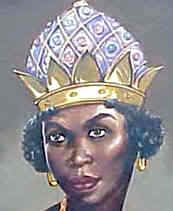
Anna Nzinga


Lived from 1581 to December 17, 1663

queen of the Ndongo (Angola), queen of Matamba Known for resisting the Portuguese in central Africa. Also known as Nzingha, Zinga, Njinja, Dona Ana de Souza.

Anna Nzinga was born the same year that the Ndongo people, led by her father, began fighting against Portuguese who were raiding their territory for slaves and attempting to conquer territory they believed included silver mines.

When Anna Nzinga's brother, Mbandi, deposed his father, he had Nzinga's child murdered. She fled with her husband to Matamba. Mbandi's rule was cruel, unpopular, and chaotic. In 1633 he asked Nzinga to return and negotiate a a treaty with the Portuguese.

Nzinga mustered a royal impression as she approached the negotiations. The Portuguese arranged the meeting room with only one chair, so Nzinga would have to stand, making her appear to be the inferior of the Portuguese governor. But she outsmarted the Europeans, and had her maid kneel, making a chair -- and making quite an impression of power.

Nzinga succeeded in this negotiation with the Portuguese governor, Correa de Souza, restoring her brother to power, and the Portuguese agreed to limits on the slave trade. Around this time, Nzinga was baptized as a Christian, taking the name Dona Anna de Souza.

In 1623, Nzinga had her brother killed, and became ruler. The Portuguese named her governer of Luanda, and she opened her land to Christian missionaries and to the introduction of whatever modern technologies she could attract. By 1626, she had resumed the conflict with the Portuguese, pointing to their many treaty violations. The Portuguese established one of Nzinga's relatives as a puppet king (Phillip) while Nzinga's forces continued to harass the Portuguese. She found allies in some neighboring peoples, and in Dutch merchants, and conquered and became ruler of the Matamba (1630), continuing a resistance campaign against the Portuguese.

In 1639, Nzinga's campaign was successful enough that the Portuguese opened peace negotiations, but these failed. The Portuguese found increasing resistance, including the Kongo and the Dutch as well as Nzinga, and by 1641 had pulled back considerably. In 1648 new troops arrived and the Portuguese began to succeed, so Nzinga opened peace talks which lasted for six years. She was forced to accept Philip as ruler and the Portuguese actual power in Ndongo, but was able to maintain her power in Matamba and to maintain Matamba's independence from the Portuguese.

Nzinga died in 1663, at the age of 82, and was succeeded by her sister in Matamba. Her rule did not rule long. Angola did not become independent of Portuguese authority until 1974.

Search under her name brothers and sisters. There is always more to learn.

Afrikan Goddess

Here's a list of SOME of the Afrikan goddesses. All should pay attention...

Aha Njoku: Known as the Lady of Yams, This popular Goddess is worshipped by the Ibo people of Nigeria. She is responsible for yams, a central ingredient in the Ibo diet, and the women who care for them.


Aja: The lady of forest herbs. This forest Goddess is honored by the Yoruba people of Nigeria. She teaches Her faithful the use of medicinal herbs found in the African forests.


Ala: Who is the Earth Mother... The Earth Mother is the highest Goddess of the Ibo pantheon of Nigeria. She is responsible for many aspects of civilization, as well as guardianship of women and children in general.


Dziva: Lady Creatrix is the generally benevolent Creatrix Goddess of the Shona people of Zimbabwe--but there is also an awful aspect to Her nature....


Gbadu: She is the Holy Daughter of Mawu (profiled below). She is the Goddess of Fate of the Fon (or Dahomey) people of modern Benin, Who is saddened by the fighting among Her Mother's mortal children.


Inkosazana: Lady Heaven... She is a popular and much-loved Goddess of the well-known Zulu people of Southern Africa. She is responsible primarily for cereal grains, an important element of the Zulu diet.


Mawu: Also known as, Lady Supreme. Mawu is the Supreme Deity of the Fon (or Dahomey) people of modern Benin. With Her husband, Lisa, She created the universe. They are sometimes presented as Mawu-Lisa the great androgymous Creator. One of Her daughters is Gbadu (profiled above).

Mbaba Mwana Waresa: The Lady Rainbow, Mbaba Mwana Waresa is a beloved Goddess of the Zulu people of Southern Africa, primarily because She gave them the gift of beer . The story of Her search for a husband is well-known, and recently appeared in a beautifully illustrated children's book.


Mella: Who is the Courageous Daughter, her story is as much folklore as it is myth. She is a deified Queen honored by the Buhera Ba Rowzi people of Zimbabwe.


Minona: The Protectress of Women is honored by the Fon (or Dahomey) people of Benin. In some tales, She is the Mother of Mawu and the Grandmother of Gbadu (both profiled above).


Oshun: The Lady of Sweet Waters. Oshun is one of the few native African Goddesses whose name is recognized in the West. She is honored by the Yoruba people of Nigeria primarily as a Goddess of fresh water, an element important to any people. She is also responsible for fertility, love and divination.

Friday, January 1, 2010

MAAFA 21

They were stolen from their homes, locked in chains and taken across an ocean. And for more than 200 years, their blood and sweat would help to build the richest and most powerful nation the world has ever known.
But when slavery ended, their welcome was over. America's wealthy elite had decided it was time for them to disappear and they were not particular about how it might be done.
What you are about to see is that the plan these people set in motion 150 years ago is still being carried out today. So don't think that this is history. It is not. It is happening right here, and it's happening right now.