Friday, February 19, 2010

Lies told to the black community

These videos expose some of the lies and statistics told to our community, which are meant to undermine us and hold us back.

Part 1


Part 2


Part 3

Tuesday, February 2, 2010

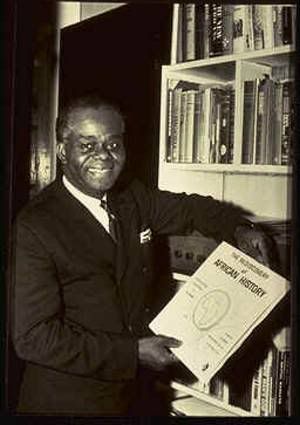
Why Africana History? by Dr. John Henrik Clarke

Why African History?


by Dr. John Henrik Clarke

Africa and its people are the most written about and the least understood of all of the world's people. This condition started in the 15th and the 16th centuries with the beginning of the slave trade system. The Europeans not only colonialized most of the world, they began to colonialize information about the world and its people. In order to do this, they had to forget, or pretend to forget, all they had previously known abut the Africans. They were not meeting them for the first time; there had been another meeting during Greek and Roman times. At that time they complemented each other. The African, Clitus Niger, King of Bactria, was also a cavalry commander for Alexander the Great. Most of the Greeks' thinking was influenced by this contact with the Africans. The people and the cultures of what is known as Africa are older than the word "Africa." According to most records, old and new, Africans are the oldest people on the face of the earth. The people now called Africans not only influenced the Greeks and the Romans, they influenced the early world before there was a place called Europe.

When the early Europeans first met Africans, at the crossroads of history, it was a respectful meeting and the Africans were not slaves. Their nations were old before Europe was born. In this period of history, what was to be later known as "Africa" was an unknown place to the people who would someday be called, "Europeans." Only the people of some of the Mediterranean Islands and a few states of what would become the Greek and Roman areas knew of parts of North Africa, and that was a land of mystery. After the rise and decline of Greek civilization and the Roman destruction of the city of Carthage, they made the conquered territories into a province which they called Africa, a word derived from "afri" and the name of a group of people about whom little is known. At first the word applied only to the Roman colonies in North Africa. There was a time when all dark-skinned people were called Ethiopians, for the Greeks referred to Africa as, "The Land Of The Burnt-Face People."

If Africa, in general, is a man-made mystery, Egypt, in particular, is a bigger one. There has long been an attempt on the part of some European "scholars" to deny that Egypt was a part of Africa. To do this they had to ignore the great masterpieces on Egyptian history written by European writers such as, Ancient Egypt. Light of the World, Vols. I & II, and a whole school of European thought that placed Egypt in proper focus in relationship to the rest of Africa.

The distorters of African history also had to ignore the fact that the people of the ancient land which would later be called Egypt, never called their country by that name. It was called, Ta-Merry or Kampt and sometimes Kemet or Sais. The ancient Hebrews called it Mizrain. Later the Moslem Arabs used the same term but later discarded it. Both the Greeks and the Romans referred to the country as the "Pearl Of The Nile." The Greeks gave it the simple name, Aegyptcus. Thus the word we know as Egypt is of Greek Origin. Until recent times most Western scholars have been reluctant to call attention to the fact that the Nile River is 4,000 miles long. It starts in the south, in the heart of Africa, and flows to the north. It was the world's first cultural highway. Thus Egypt was a composite of many African cultures. In his article, "The Lost Pharaohs of Nubia," Professor Bruce Williams infers that the nations in the South could be older than Egypt. This information is not new. When rebel European scholars were saying this 100 years ago, and proving it, they were not taken seriously.
It is unfortunate that so much of the history of Africa has been written by conquerors, foreigners, missionaries and adventurers. The Egyptians left the best record of their history written by local writers. It was not until near the end of the 18th century when a few European scholars learned to decipher their writing that this was understood.

The Greek traveler, Herodotus, was in Africa about 450 B.C. His eyewitness account is still a revelation. He witnessed African civilization in decline and partly in ruins, after many invasions. However, he could still see the indications of the greatness that it had been. In this period in history, the Nile Valley civilization of Africa had already brought forth two "Golden Ages" of achievement and had left its mark for all the world to see.
Slavery and colonialism strained, but did not completely break, the cultural umbilical cord between the Africans in Africa and those who, by forced migration, now live in what is called the Western World. A small group of African-American and Caribbean writers, teachers and preachers, collectively developed the basis of what would be an African Consciousness movement over 100 years ago. Their concern was with African, in general, Egypt and Ethiopia, and what we now call the Nile Valley.
In approaching this subject, I have given preference to writers of African descent who are generally neglected. I maintain that the African is the final authority on Africa. In this regard I have reconsidered the writings of W.E.B. DuBois, George Washington Williams, Drusilla Dungee Houston, Carter G. Woodson, Willis N. Huggins, and his most outstanding living student, John G. Jackson. I have also re-read the manuscripts of some of the unpublished books of Charles C. Seifert, especially manuscripts of his last completed book, Who Are The Ethiopians? Among Caribbean scholars, like Charles C. Seifert, J.A. Rogers (from Jamaica) is the best known and the most prolific. Over 50 years of his life was devoted to documenting the role of African personalities in world history. His two-volume work, World's Great Men of Color, is a pioneer work in the field.
Among the present-day scholars writing about African history, culture and politics, Dr. Yosef ben-Jochannan's books are the most challenging. I have drawn heavily on his research in the preparation of this article. He belongs to the main cultural branch of the African world, having been born in Ethiopia, growing to early manhood in the Caribbean Islands and having lived in the African-American community of the United States for over 20 years. His major books on African history are: Black Man of the Nile, 1979, Africa: Mother of Western Civilization, 1976, and The African Origins of Major Western Religions, 1970.
Our own great historian, W.E.B. DuBois tells us,

"Always Africa is giving us something new . . . On its black bosom arose one of the earliest, if not the earliest, of self-protecting civilizations, and grew so mightily that it still furnishes superlatives to thinking and speaking men. Out of its darker and more remote forest vastness came, if we may credit many recent scientists, the first welding of iron, and we know that agriculture and trade flourished there when Europe was a wilderness."

Dr. DuBois tells us further that,
"Nearly every human empire that has arisen in the world, material and spiritual, has found some of its greatest crises on this continent of Africa. It was through Africa that Christianity became the religion of the world . . . It was through Africa that Islam came to play its great role of conqueror and civilizer."
Egypt and the nations of the Nile Valley were, figuratively, the beating heart of Africa and the incubator for its greatness for more than a thousand years. Egypt gave birth to what later would become known as "Western Civilization," long before the greatness of Greece and Rome.
This is a part of the African story, and in the distance it is a part of the African-American story. It is difficult for depressed African-Americans to know that they are a part of the larger story of the history of the world. The history of the modern world was made, in the main, by what was taken from African people. Europeans emerged from what they call their "Middle-Ages," people-poor, land-poor and resources-poor. And to a great extent, culture-poor. They raided and raped the cultures of the world, mostly Africa, and filled their homes and museums with treasures, then they called the people primitive. The Europeans did not understand the cultures of non-Western people then; they do not understand them now.
History, I have often said, is a clock that people use to tell their political time of day. It is also a compass that people use to find themselves on the map of human geography. History tells a people where they have been and what they have been. It also tells a people where they are and what they are. Most importantly, history tells a people where they still must go and what they still must be.
There is no way to go directly to the history of African-Americans without taking a broader view of African world history. In his book, Tom-Tom, the writer John W. Vandercook makes this meaningful statement: A race is like a man.

Until it uses its own talents, takes pride in its own history, and loves its own memories, it can never fulfill itself completely. This, in essence, is what African-American history and what African-American History Month is about. The phrase African-American or African-American History Month, taken at face value and without serious thought, appears to be incongruous. Why is there a need for an African-American History Month when there is no similar month for the other minority groups in the United States. The history of the United States, in total, consists of the collective histories of minority groups. What we call 'American civilization' is no more than the sum of their contributions. The African- Americans are the least integrated and the most neglected of these groups in the historical interpretation of the American experience. This neglect has made African-American History Month a necessity.

Most of the large ethnic groups in the United States have had, and still have, their historical associations. Some of these associations predate the founding of the Association For The Study of Negro Life and History (1915). Dr. Charles H. Wesley tells us that, "Historical societies were organized in the United States with the special purpose in view of preserving and maintaining the heritage of the American nation."

Within the framework of these historical societies, many ethnic groups, Black as well as white, engaged in those endeavors that would keep alive their beliefs in themselves and their past as a part of their hopes for the future. For African-Americans, Carter G. Woodson led the way and used what was then called, Negro History Week, to call attention to his people's contribution to every aspect of world history. Dr. Woodson, then Director of the Association For the Study of Negro Life and History, conceived this special week as a time when public attention should be focused on the achievements of America's citizens of African descent.

The acceptance of the facts of African-American history and the African-American historian as a legitimate part of the academic community did not come easily. Slavery ended and left its false images of Black people intact. In his article, "What the Historian Owes the Negro," the noted African-American historian, Dr. Benjamin Quarles, says:

"The Founding Fathers, revered by historians for over a century and a half, did not conceive of the Negro as part of the body of politics. Theoretically, these men found it hard to imagine a society where Negroes were of equal status to whites. Thomas Jefferson, third President of the United States, who was far more liberal than the run of his contemporaries, was never the less certain that "the two races, equally free, cannot live in the same government."

I have been referring to the African origin of African-American literature and history. This preface is essential to every meaningful discussion of the role of the African-American in every aspect of American life, past and present. I want to make it clear that the Black race did not come to the United States culturally empty-handed. The role and importance of ethnic history is in how well it teaches a people to use their own talents, take pride in their own history and love their own memories. In order to fulfill themselves completely, in all of their honorable endeavors it is important that the teacher of history of the Black race find a definition of the subject, and a frame of reference that can be understood by students who have no prior knowledge of the subject. The following definition is paraphrased from a speech entitled, "The Negro Writer and His Relation To His Roots," by Saunders Redding, (1960): Heritage, in essence, is how a people have used their talent to created a history that gives them memories that they can respect, and use to command the respect of other people. The ultimate purpose of history and history teaching is to use a people's talent to develop an awareness and a pride in themselves so that they can create better instruments for living together with other people. This sense of identity is the stimulation for all of a people's honest and creative efforts. A people's relationship to their heritage is the same as the relationship of a child to its mother. I repeat: History is a clock that people use to tell their time of day. It is a compass that they use to find themselves on the map of human geography. It also tells them where they are, and what they are. Most importantly, an understanding of history tells a people where they still must go, and what they still must be.

Early white American historians did not accord African people anywhere a respectful place in their commentaries on the history of man. In the closing years of the nineteenth century, African- American historians began to look at their people's history from their vantage point and their point of view. Dr. Benjamin Quarks observed that "as early as 1883 this desire to bring to public attention the untapped material on the Negro prompted George Washington Williams to publish his two-volume History of The Negro Race in America from 1619 to 1880. The first formally trained African-American historian was W.E.B. DuBois, whose doctoral dissertation, published in 1895, The Suppression Of The African Slave Trade To The United States, 1638-1870, became the first title to be published in the Harvard Historical Studies. It was with Carter G. Woodson, another Ph.D., that African world history took a great leap forward and found a defender who could document his claims. Woodson was convinced that unless something was done to rescue the Black man from history's oversight, he would become a "negligible factor in the thought of the world. " Woodson, in 1915, founded the Association for the Study of Negro Life and History. Woodson believed that there was no such thing as, "Negro History. " He said what was called "Negro History" was only a missing segment of world history. He devoted the greater portion of his life to restoring this segment.

Africa came into the Mediterranean world, mainly through Greece, which had been under African influence, and then Africa was cut off from the melting pot by the turmoil among the Europeans and the religious conquests incident to the rise of Islam. Africa, prior to these events, had developed its history and civilization, indigenous to its people and lands. Africa came back into the general picture of history through the penetration of North Africa, West Africa and the Sudan by the Arabs. European and American slave traders next ravaged the continent. The imperialist colonizers and missionaries finally entered the scene and prevailed until the recent re-emergence of independent African nations.

Africans are, of course, closely connected to the history of both North and South America. The African-American's role in the social, economic and political development of the American states is an important foundation upon which to build racial understanding, especially in areas in which false generalization and stereotypes have been developed to separate peoples rather than to unite them. Contrary to a misconception which still prevails, the Africans were familiar with literature and art for many years before their contact with the Western World. Before the breaking-up of the social structure of the West African states of Ghana, Mali and Songhay and the internal strife and chaos that made the slave trade possible, the forefathers of the Africans who eventually became slaves in the United States, lived in a society where university life was fairly common and scholars were held in reverence.

To understand fully any aspect of African-American life, one must realize that the African-American is not without a cultural past, though he was many generations removed from it before his achievements in American literature and art commanded any appreciable attention. Africana, or Black History, should be taught every day, not only in the schools, but also in the home. African History Month should be every month. We need to learn about all the African people of the world, including those who live in Asia and the islands of the Pacific.

In the twenty-first century there will be over one billion African people in the world. We are tomorrow's people. But, of course, we were yesterday's people, too. With an understanding of our new importance we can change the world, if first we change ourselves.

The late Dr. John Henrik Clarke, a pre-eminent African-American historian, author of several volumes on the history of Africa and the Diaspora, taught inthe Department of Black and Puerto Rican Studies at Hunter College of the City University of New York.

Originally published in THE BLACK COLLEGIAN Magazine (1997).

Friday, January 22, 2010

"A Dissenting View" by Dr. John Henrik Clarke


A Dissenting View
by John Henrik Clarke

________________________________

The following is Dr. Clarke's response to "Black Demagogues and Pseudo-Scholars"
________________________________

In reference to the OP-ED of Henry Louis Gates Jr. the New York Times (Monday, July 20, 1992), entitled "Black Demagogues and Pseudo-Scholars," I am raising the following questions: At once, I questioned the title of Professor Gates' article. He should never refer to anyone as a demagogue unless he's ready to call the names of the demagogues, singular or plural, and point out the nature of their demagoguery. He should never refer to any scholar as being pseudo, unless he is ready to name the scholar and prove the pseudo nature of his or her work. To disagree with a scholar does not make the scholar a demagogue.

Most of the old and new Black scholars asking for a total reconsideration of African history, in particular, and world history, in general, are using neglected documents by radical White Scholars who are generally neglected by the White academic community.

In African history I am referring to scholars like Gerald Massey and his work, Egypt, Light of the World, (two volumes), The Book of the Beginnings, (two volumes) and Natural Genesis, (two volumes).

I am also referring to Gerald Massey's greatest English disciple, Albert Churchward, whose book, The Signs and Symbols of Primordial Man, asks for a reconsideration of the role of people outside of Europe and their role in human development.

Your attention should also be called to the work, Anacalypsis, two volumes by Godfrey Higgins, published in 1837. These books deal with the dispersions of African people throughout the world.

Many of these Black scholars, whose work Professor Gates questioned, were reading works by Whites in French, German and other languages that spoke positively about African American achievement long before Mr. Gates' parents were born.

This school of Black scholars are neither demagogues nor are they pseudos; they are the forerunners of the present propagators of Afrocentricity. They know what Professor Gates doesn't seem to know: that African people are the most written about and the least understood people in the world.
If Professor Gates has not read the works of the White pioneer scholars about the role of African people in world history, it stands to reason that he has no understanding of the senior Black scholars such as Yosef ben-Jochannan, John G. Jackson, Cheikh Anta Diop, Jacob Carruthers, Chancellor Williams, Lao Hansberry and myself.

Professor Gates' reference to Black anti-Semitism is an exaggeration. A new Black awareness is causing Blacks, young and old, to question everything that has any influence on their lives. We are realizing that Jewish people have an influence on our lives far out of proportion to their numbers in the population. I totally disagree with Professor Gates that anti-Semitism among Whites is on the wane in the country. Quite the contrary, I think it is increasing in this country and in the world, and Black people are not the cause of it.

What you have in this new charge of Black and Semitism against Blacks is the most pathetic of all tragedies, a scapegoat looking for a scapegoat. Because of Black Americans' reading or misreading of the Bible, we have always had a sentimental attachment to Jewish people and, to a large extent, most of us still do. During slavery, we wanted to attach ourselves to a people who had escaped from bondage. So, the Exodus story in the Bible became more real to us than to the Jewish people. Right now, in a large number of Black Baptist churches, you can get a large number of the congregation to shed real tears of sympathy over the three Hebrew boys in the fiery furnace. Most of them dare not question whether this is folklore or fact.

There are well over 300 organized White hate groups in the United States. I know of no overt attacks by the Jews being made on any of them. Yet, Jewish people have attacked Louis Farrakhan more than they have attacked the leaders of the Aryan Nation or the American Nazi Party. Are the Jews in America looking for an easy victory or the Truth? Black Americans have never been their enemy. And they, the Jews, have never been our friends unless it was to their convenience. Neo-Nazism has fully re-emerged in Germany and in other states in Europe. These are people with a nation structure and armies. Why is it that a group of weak Black Americans are getting more attention from the Jews than these powerful White forces rising against them?

I'm sorry that Professor Cornell West saw fit to make a statement about this false charge of Black anti-Semitism. I could agree with his statement if the statement were true. What Black people are realizing in this country, in the Caribbean Islands and in Africa is that the Jewish people, of European descent, are a part of the world apparatus of European control. And, in the matter of White control over the world, their position is no different than that of other Europeans. I am not saying that the Jews of Europe are more bent on world dominance than other Europeans; I am saying that they are not radically different from other Europeans in this regard. Internal disputes between the Jews and other Europeans is a form of European domestic racism. European racism has spent itself out outside of Europe. During the Nazi regime in Germany, that racism turned inward on itself and created what is referred to as The Holocaust. This was a problem started in
Europe by Europeans that should have been resolved in Europe by Europeans.

Repeatedly I have said that Europeans are geniuses at draining the diseased pus of their political sores on the lands of other people. What is now being called anti Semitism among a newly awakened Black intellectual class is that they are beginning to look at the people referred to as Jews as part of the totality of European world dominance. We are not saying that the European who is a Jew is any more of an imperialist than any other of the Europeans, but that he is basically the same. We are not saying that the role of the Jews in the slave trade was any different then any other Europeans, but that it was basically the same. When they saw the opportunity to make money in the slave trade, they took advantage of this opportunity the same as other Europeans in the same business.

I do not choose to deal with Jesse Jackson's opportunistic appearances at the World Jewish Congress and the statements that he made. Jesse Jackson has his own agenda that is unrelated to the Liberation Movement of his own people. He was catering to his Jewish audiences for reasons unrelated to Black people and their liberation movements.

Black people are becoming increasingly conscious of people who exploit their community and hold them in contempt. We make no exceptions when these exploiters are non-European.

In referring to present-day anti-Semitism and the attempt to trace it to having roots in Christianity, Professor Gates shows his lack of understanding of the manifestation of Christianity among American Blacks and how that interpretation of this religion is part of their humanity. Their interpretation, in no way, relates to anti-Semitism.

I wonder if Professor Gates would explain the words in the Negro spiritual:
Go down Moses ...
Tell ol' Pharaoh
To let my people go.
or the words:
Deep river,
My home is over Jordan.

This is African identification with the Biblical people of the Hebrew faith. It would help if Professor Gates would read a towering masterpiece in three volumes by James Fraser, The Folklore in the Old Testament and another contemporary book, Hebrew Myths, edited by Robert Graves and Raphael Patai.

I do not think that Professor Gates completely read Michael Bradley's The Iceman Inheritance before referring to it because in it Michael Bradley has very little to say about the Jews. The book, in essence, is about the rise of a certain kind of temperament that changed the world-the European Personality. This personality has shown little or no respect for civilizations, cultures and ways of life that it did not create. Cultures and people that the European did not understand were declared primitive.

In the last 500 years especially, European historians have inferred, or said outright, that the world waited in darkness for the Europeans to bring the light. In fact, the Europeans destroyed more civilization than they ever created. They destroyed civilizations that were already old before Europe was born.

Michael Bradley was characterizing the Europeans as "Icemen" is not totally incorrect, if it is incorrect at all. I wrote the Introduction to the new edition of this book, because I considered the book to be of some significance in explaining the origin of racism. I did not say the book was a masterpiece of the greatest achievement in writing. It was good basic research and told honesty about Europeans' beginnings and the impact of racism on the broader world. I have also written the Foreword to another book by Michael Bradley that will be even more controversial, Chosen People From The Caucasus: Jewish Origins, Delusions Deceptions, and Historical in the Slave Trade, Genocide Cultural Colonization. (Third World Press, Chicago).
My writing on Black-Jewish relationships is not new. I participated in forums on this subject in the old Harlem History Club in the 30s. In my latest book, Notes for an African World Revolution: Africans at the Crossroads, (Africa World Press, Trenton, 1991), Chapter Four is called 'Africa, Zionism, and Friends Without Friendship." This is an analysis of 500 years of African-Jewish relationships. I am not writing about an historical Black-Jewish affiance, because the one often referred to is a myth. There can be no successful alliance between weak people and strong people.

There have been times when it was to the best interest of the Jews to support certain Black causes, and they have supported them. When it was no longer in their interest, they withdrew from them. The Jewish people have practiced what all people on this earth have a right to practice the essential selfishness of survival.

Indeed, I have criticized multiculturalism and Jewish control over the education system in New York City and the education system in the United States, in general, especially the Teachers Union. Jews have had no compunction in fighting for a holocaust curriculum. And in many schools it is mandated and Black students must learn about the Holocaust before they learn about their own history.

Over the years, I have said repeatedly I am not willing to argue whether Hitler killed 6,000,000 or six. He was wrong if he only killed six. I think he committed one of the greatest crimes in history. No human being would ever approve of this crime. If we are honest about historical information, we would know that the mass murder and what is referred to as the Holocaust was a small event in comparison to other mass murder events in history. The Belgians killed three times more people than this in the Congo. In an island near Australia called Tasmania, the British killed every man, woman and child. In the years of the slave trade, Africa lost, over one hundred million people. For every African captured, three were killed. The Arab slave trade in East Africa that started a thousand years before the European Atlantic slave trade and the Atlantic slave trade that lasted approximately 300 years was a holocaust against African people, which started 500
years ago and is not completely over to this day.

If the four policeman in Los Angeles had been beating a dog instead of Rodney King, they would have been put on trial and convicted. It is time to speak of the Great Holocaust in history. The European holocaust, I repeat, was small in comparison to some of the others.

When Professor Gates refers to me as the paterfamilias of the Afrocentric movement," I'm not too clear about whether this is a compliment or a thinly veiled insult. I did not go to the dictionary to look up the words because I never use dollar words in 25 cents situations. But, as a matter of fact, my interest in African history and world history in general started when I was a Baptist Sunday School teacher in Columbus, Georgia, where I grew to early manhood. I could not find the image of my people in the Bible, so I began the search through the literature of the world until I found them and learned why some people considered it a necessity to leave African people out of the respectful commentary of history. I became active in the old Harlem History Club at the Harlem YMCA soon after arriving in New York City at the age of 18 in 1933.

The study of African history, culture and politics and world history in general has been the all-prevailing passion of my existence. It is something I do, like breathing is something I do.

I think too much fuss has been made of the case of Professor Jeffries who has said nothing that he cannot document. It is too often forgotten that most of the information Professor Jeffries gave on the slave trade was taken from Jewish writers.

The book, The Grandees, by Steven Birmingham, set his search in motion. He read large numbers of documents over and beyond that book, such as more revealing books by Professor Ben-ram Wallace Korn: Jews and Negro Slavery in the Old South 1789-1865, (1961), and The Early Jews of New Orleans, (1969).

The story of Aaron Lopez of Newport, Rhode Island, is too well-known to be retold here. Conrad Muhammad and Kahlid Kahfah are not intellectual cohorts with Professor Jeffries. I doubt if he's met either one of them. Neither one of these men belong to the academic community, nor is either one well read enough to be classified as a scholar. They are mainly Moslem zealots; not too different from zealots of other religions.

I have no argument for or against the Learned Protocols of the Elders of Zion. I have not been able to authenticate it one way or the other. If someone assures me that it is a piece of fiction, I am not prepared to argue.
Professor Gates' complaint about the book, The Secret Relationship Between Blacks and Jews seems without justification. The book is no masterpiece. It is a competent piece of research. The documentation is good. Instead of complaining about the footnotes, Professor Gates should read some of the footnotes and the books they refer to; especially he should read the works of Professor Bertram W. Korn, an able Jewish scholar whose writings about the role of American Jews in the slave trade is most revealing. Professor Gates should also learn that neither Blacks nor Jews can go on forever denouncing every thing that is not in their favor.

Honest sentiment and some very able research in favor of the Jewish people was started in the old Harlem History Club by Willis N. Huggins in the 30s. Some of the best known of these findings were published in the Chicago Defender and in the magazine, The African. The following quote is from Willis N. Huggins' article, "How Wrong is Hitler?...On the History of Jews, Black Folk and 'Aryanism?'" (Chicago Defender, Chicago, January 28, 1939).
When the news broke in the American Press on July 15th that the Italians were ready to go tread "The Aryan Path," it evoked as much laughter as the world may get when news comes from Germany that Max Schmeling has been cast out of the "Aryan Fold" because "anonymous scientists" have discovered that he has a grandfather named Goldberg. "Political Aryanism," according to a prominent Nazi leader, "aims to turn its ire against Jews, Gypsies and the Negro races."

Since Jews are able to take care of their part of this "sentence" and, doubtless, the Gypsy does not give a hoot I should like to summarize the reactions of black folk to the new "Aryan Wave." If we should look at the records we would see that the early Aryan language-groups stemmed from the black Dravidians who occupied southern India in remote times. 'Me two peoples mingled freely. Thus, the so-called Indo-European movements around 2,500 B.C., were basically migrations of a Negroid folk which pooled itself in southern southeastern and southwestern Europe, around 2,000 B.C. Indeed black African races, The Grimaldi" had already covered most of Europe as early as 20,000 B.C. They left a secondary African base for art in ancient Hellas (Greece) and a primary African base for color in Austria, Italy, France, Spain and Portugal.

Willis N. Huggins also wrote a series of articles on the African origin of Adolf Hitler's racist symbols. In my opinion, I think both Blacks and Jews are often arguing about the right thing the wrong way. Jews who lived in slave trading countries participated in the slave trade as citizens of the respective country. Slavery was a business, a dirty business, but still a business. Business people engage in any business where profit can be made. The same thing is true about business people living in colonial countries in relationship to African people. I place no special blame on Jewish people who are white Europeans. I offer no special vindication, either. Their behavior in relationship to non-Europeans is basically the same as other Europeans. The internal difference and difficulties that Jews have had within the White family does not alter or change what I have just said.
What Professor Gates, the Jews and some people referred to as "Black Conservatives" fail to understand is that the African people throughout the world have suffered a special catastrophe over and above that of other people of the world. When Europeans rose in the 15th and 16th century, started the slave trade, colonized history and information about history, they also colonized the image Of God. They took away from millions of people the image of their original God-concept and replaced him or her by a god conceived in Europe. Again, I ask Professor Gates and other Black conservatives to try to understand that for 500 years we have lived in a European-conceived intellectual universe. I am willing to acknowledge that I am influenced by this conception, but I am, at least, at war against it because I realize that it is not only detrimental to my people, it is detrimental to the whole world. Professor Gates and other Black conservatives are the crawling dogs to this new design to continue European world dominance.

Professor Gates is snide in his assumption that "We can rarely bring ourselves to forgive those who have helped us." The truth is the contrary. African people have always over-rewarded those who have helped them, often to their detriment. I wish he would explain the nature of the help and the time it was given. All people that have come among us have taken more than they have given and have eventually done us more harm than good. If you forgive the modesty, I refer you to my pamphlet, Black, White Alliances: A Historical Perspective (Third World Press, Chicago, 1971).
Professor Gates keeps referring to an historical alliance between Blacks and Jews. I wish he would be more precise and say when this historical alliance occurred. I have been a teacher of African World History most of my life and a student of history in general. I know of no evidence indicating such an alliance. The earliest opportunity for a coalition between Blacks and Jews came in 1675 B.C., when an African people called the Egyptians took in the sons and daughters of Abraham, who were fleeing from hunger and starvation in Western Asia. After receiving food, clothing and shelter as well as the foundation for Judaic culture, language and religion, the majority of these a guests" joined the invaders, the Hyksos (or Shepherd Kings) rather than form an alliance to defend the country of their African benefactors. They had found a greater acceptance in Africans than Africans have ever found in a European-dominated country. With this visit to Africa, the
people who would later be known as Jews conspicuously entered world history.

Professor Gates, Cornel West and other Black conservatives use beautiful words, sometimes to say nothing, sometimes to say what has already been said and sometimes to say what is not in debate. They display their ignorance of European history and history in general. They decry any form of Black nationalism and often call it racism without knowing that for the last 500 years the world has been controlled by European or White nationalism.

African self-assertion, the demand for a proper curriculum in the schools demand that we stop praising a liar and a faker like Christopher Columbus who discovered absolutely nothing-threatens an apparatus of European control set in motion by the Atlantic slave trade and continued with colonialism that ultimately laid the basis for present-day monopoly capitalism. No matter what Europeans say they believe religiously, politically or culturally, their main objective in the world is control. Everything that has ever been developed in the European mind was meant to facilitate mind control of the world. There are no exceptions, Left or Right politically.

Black conservatives are really frustrated slaves crawling back to the plantation, figuratively, letting their master know that they are willing to go back into bondage. One needs to question their words because, as slaves and enemies of their people, they will say what they are told to say and do what they are told to do. The Black conservatives have nothing to conserve except their miserable obscurity and their tragic cowardice. These pathetically lost creatures and avid White behind kissers don't have the nerve to be African or Black.

To be African or Black with the understanding of all of its ramifications is, in itself, a commitment to the unification and uplift of all African people on the face of this earth. It is a commitment, also, to take Pan-Africanism beyond its narrow base of Black nationalism to a concept of an African world union.
When the real tragedy of Black-Jewish relations is finally identified, I think it will be the dictionary and how we have misused its words. Here is a case where semantics change depending on who is listening and what they are listening for. Your listener will often hear what you did not say and stubbornly ignore what you said. The present controversy around Black and Jewish relations is a good example of a poor and unimaginative use of words.

What exactly do we mean by Black-Jewish relations? From these words we have no way of knowing that there are Blacks who are also Jews, members of the Hebrew faith.

There is a genuine conflict between Black and Jewish people, and this conflict has international implications. We can not deal with this conflict honestly until we call it by its correct name and examine its origin and development. African people the world over have no culture or religious fight with Jewish people. We come out of pluralistic societies, of our own making, where we lived side by side with a multiplicity of cultures and religions, most of the time in peace. Cultural and religious tolerance is part of our heritage as a people. If we were disposed to be against any culture or religion, it would probably not be Jewish culture and religion that had part of its early development in Africa.

Now that I have eliminated culture and religion as the basis of the Black-Jewish conflict, precisely what is the conflict about? It is about power and the emerging expectations of most of the world's people who until recently were mainly ruled by Europeans or people of European extraction.
The one thing the conflict is not about is anti-Semitism. There is a world-wide Black-White conflict which is part of the broader conflict between European and non-European people. African people are on one side of that conflict, and the people we refer to as Jews are on the other side.
When I use the words Jews or Jewish people, I am referring to White people of European descent, whose culture, development and political loyalty is European. This political loyalty to Europe and the part that Jewish people still play in maintaining European world-wide power, and not anti-Semitism, is the basis of the conflict between us. This conflict will become more fierce and tragic as non-European people challenge the power of European people all over the world.

With urgency I invite you to read Yosef A.A. ben-Jochannan's book, We the Black Jews and the book by John G. Jackson, Christianity Before Christ. I believe that Blacks and Jews need a genuine partnership. Before one can be built both of them have to be honest in admitting that they have no partnership now. Figuratively speaking, the partnership between a horse and a rider is neither a partnership or an agreement.

Today the Jews are aligning themselves with the forces of White supremacy that is diametrically opposed to the interest of most of mankind. I think they have made a political mistake of disastrous proportions, and I compare their present political position with the period of Joseph and his brothers in Egypt and the period and time that followed the loss of political connections with the Egyptian Court that Joseph made for them.

And I wonder will their present position lead to another time when a king will arise, figuratively speaking, who politically knew not Joseph.

Monday, January 18, 2010

Free Fall Towards Genocide

Part 1


Part2


Part 3


Part 4

Friday, January 15, 2010

The 42 Ideals of Maat


1. I honor virtue

2. I benefit with gratitude

3. I am peaceful

4. I respect the property of others

5. I affirm that all life is sacred

6. I give offerings that are genuine

7. I live in truth

8. I regard all altars with respect

9. I speak with sincerity

10. I consume only my fair share

11. I offer words of good intent

12. I relate in peace

13. I honor animals with reverence

14. I can be trusted

15. I care for the earth

16. I keep my own council

17. I speak positively of others

18. I remain in balance with my emotions

19. I am trustful in my relationships

20. I hold purity in high esteem

21. I spread joy

22. I do the best I can

23. I communicate with compassion

24. I listen to opposing opinions

25. I create harmony

26. I invoke laughter

27. I am open to love in various forms

28. I am forgiving

29. I am kind

30. I act respectfully of others

31. I am accepting

32. I follow my inner guidance

33. I converse with awareness

34. I do good

35. I give blessings

36. I keep the waters pure

37. I speak with good intent

38. I praise the Goddess and the God

39. I am humble

40. I achieve with integrity

41. I advance through my own abilities

42. I embrace the All

Commemorating Haiti: A revolutionary history

Commemorating Haiti: A revolutionary history
Kimani Waweru
2009-04-30, Issue 430
http://pambazuka.org/en/category/comment/55997
Printer friendly version


Robert MillerReflecting on Haiti’s current instability and tumultuous existence, Kimani Waweru provides an historical analysis of the Caribbean island, speculating that the root causes of problems affecting Haiti also transpire in Kenya and much of the developing world. By establishing a correlation between Haitian and Kenyan experiences, the author proposes a need for Kenya to learn from Haiti’s struggle. Despite its remarkable success in being the first Latin American country to gain independence, the first post-colonial nation with a black leadership, and the only country to have gained independence through a successful slave rebellion, Haitians have been subjected to unfathomable duress. Colonialism, slavery, exploitation, invasion, occupation, and corruption in politics have permeated Haiti’s historical landscape. Through the adoption of revolutionary ideology and the elimination of Western rhetoric, which fails to prioritise citizens’ interests, Waweru believes Kenyans can counter imperialism's strength and foster an arena for social justice.


I will try to relate Haiti’s experience to our own so as to learn from this country’s weaknesses and strengths. By doing this, we will be able to understand the root causes of problems bedevilling Kenya and the Third World. Knowing the cause of these problems will enable us to tackle and solve them.


Haiti has featured prominently in world news for a number of years, most of the time for negative reasons. A few months ago, a hurricane swept some parts of the country, causing great damage. Over 100 people lost their lives. As one of the poorest countries in the Caribbean – about 80 per cent of the population survives on less than two dollars a day, and a half of its population on less than a dollar a day – Haiti’s health facilities are in a pathetic state. A large percentage of the population is unable to feed its families. Nonetheless, one questions why a country blessed with a good climate and agricultural opportunities experiences such life-threatening issues. It is paramount to revisit Haiti’s historical trajectory in order to understand the nation’s current instability.


Before invasion by foreigners, Haiti belonged to a group of people called Taíno, meaning ‘men of the good’. Arriving from Spain, Christopher Columbus was the first foreigner to set foot on the island. It is frequently claimed that Columbus ‘discovered’ the island in 1492, indicating that the indigenous Taínos he encountered were not human beings. Columbus invited Spanish colonial settlers to exploit Haiti's wealth, particularly gold, enslaving Taínos within their own land. The Spanish colonialists proceeded to brutally exterminate the entire Taíno population, creating a shortage of human labour. Thus, in 1503 the colonialists brought black people from Spain to work in Haiti’s mines.


When the French arrived in Haiti in 1625, conflict arose between them and the Spaniards over Haiti’s wealth. The fight ended in the signing of the Ryswick Treaty in 1697. The treaty gave France control over Haiti, which was known as Saint-Domingue at the time. To exploit Haiti's wealth, France embarked on a mass importation of slaves from Africa. The slaves were forced to work under extreme conditions to produce wealth, which solely benefited the slave masters.


Black slaves did not sit around waiting for the messiah to save them or hoping to get sympathy from the slave masters, rather they demonstrated resistance in various ways. For example, some took to the mountains where they attacked and killed slave masters. This rebellion culminated in the rise of an inspirational leader called Toussaint L'Ouverture. L’Ouverture organised an army of slaves which terrorised French exploiters. Because of his leadership, slaves believed in themselves and were able to fight with determination.


To end the resistance, the French tricked L’Ouverture into agreeing a deal and subsequently arrested him in 1802. He was taken to prison in France, where he died of pneumonia. Haiti’s slave population did not despair; they continued with the fight.

By 1 January 1804, Haiti became the first black country, and the second in the world – after the United States – to regain independence, under the leadership of Jean-Jacques Dessalines, who had taken over from L’Ouverture.


Upon taking over, Dessalines ordered the killing of Frenchmen who remained in Haiti. This action angered the international community, particularly the US and Western Europe, illustrated through a refusal to recognise this newly founded government.


Haiti assisted, and expressed solidarity with Latin American countries struggling for freedom. The great Latin American liberator, Simon Bolívar was once granted asylum in Haiti. In 1825, under the leadership of President Jean-Pierre Boyer, Haiti surrendered to France's demand of 150 million francs as compensation for controlling resources which purportedly belonged to French citizens following independence. The previous ruling regimes had refused France’s demand. This capitulation led to Haiti’s dependence on France. Boyer was eventually overthrown in 1843.


During the leadership of Jean Vibrun Guillaume Sam in 1915, the US invaded Haiti and occupied the country for 19 years, ostensibly because Vibrun had killed 167 political prisoners. Thereafter, the US ruled Haiti through proxies, and even pushed for the amendment of an article in Haiti’s constitution banning foreigners from owning Haitian land.

After the US left the country in 1934, there followed several leaders, with the election of François Duvalier in 1957 garnering the most attention due to the president’s infamous anti-people policies. Prior to his presidency, Duvalier excelled in articulating issues affecting common people. In 1963, he entrenched himself as the future of Haiti’s leadership by changing the constitution to ensure he maintained his presidential position for life. He died in 1971, and his son Jean-Claude Duvalier, whom he had designated as his heir, was made president at the age of 19.


As the younger Duvalier continued to operate according to policies implemented by his father, he failed to bring the change highly sought after by Haitians, leading many to become dissatisfied with the Duvalier dynasty and expressing a desire to depose it.


Under the leadership of a Catholic priest called Jean-Bertrand Aristide, peasants, urban workers and members of the petty bourgeoisie took to the street demanding Duvalier's resignation. Aristide was the leader of the Fanmi Lavalas, a movement which played a crucial role in the uprising.


On 7 February 1986, Jean-Claude Duvalier gave in to mounting pressure, resigned and fled the country, marking the conclusion of this loathed dynasty.

From 1986 to 1990, Haiti was ruled by provisional governments, which amended the constitution. In the first election under the new constitution held in 1990, Aristide emerged the victor with 67 per cent of the votes cast. This election was perceived as the first free and fair election in the history of Haiti. The US was uncomfortable with Aristide because of his combination of liberation theology and anti-capitalist rhetoric, thus the American government chose to support Aristide’s opponent, a former World Bank official, Marc Bazin.


The US approved of a death squad called FRAPH, implemented to destabilise the Aristide government. The destabilisation led to Aristide’s overthrow in September 1991 in which the US secretly backed a military coup. General Raoul Cedras, named chief of general staff of Haiti’s army by Aristide, did exactly what Joseph Mobutu had done to the Congolese leader Patrice Lumumba in the early 1960s, cooperating with the US to overthrow the country's leader. Poor people did not take this lightly and poured into the streets to protest. Their protests were mercilessly crushed by the military regime. It is estimated that under this military reign approximately 7,000 people were killed.


Because of the oppression and economic hardship that followed, many people fled to the US using motor boats. Most of them were deported back to Haiti. The US government had to encourage Haiti’s military regime to step down and let Aristide complete his term. The United Nations Security Council backed the removal of the military regime.


The US government set conditions which the Aristide government had to honour upon returning to power. These conditions included complying with IMF and World Bank conditionalities, co-opting former officials of the Duvalier dictatorship and accepting to complete the term without seeking re-election at its conclusion. Acceptance of these conditions made Aristide unpopular among his supporters, since his compliance affected them negatively. When Aristide’s term culminated in 1996, he persuaded his friend, Rene Preval, to run for president under the Lavalas party. Preval won the election with 88 per cent of votes.


Due to party differences there was a split between the two friends, which led to Aristide forming a breakaway movement called Lavalas Family. When the next election was held in 2000 and was boycotted by the opposition, Aristide emerged triumphantly with 90 per cent of votes.


To counter the Democratic Convergence coalition and Group 184 formed by the US and Haitian ruling classes to destabilise him, Aristide relied on in his Chimères security force, comprised of lumpenproletariat, namely, the impoverished from Haiti’s slums. This force attacked Aristide’s opponents, who in turn formed similar forces to counterattack. Knowing that they could not beat Aristide in a fair election, his opponents formulated excuses, suggesting that the 2000 elections were irregular. Aristide’s opponents were fully supported by the US and other Western countries, who suspended foreign aid to the Aristide government as a symbol of protest around unfair elections. The suspension of aid was meant to turn Haitians against Aristide.


By February things had turned from bad to worse; the US capitalised on this downturn, and facilitated another coup which involved abducting Aristide and his family then flying them to the Central African Republic (CAR). The US insisted that they were helping Aristide since he had resigned. Aristide was later given political asylum in South Africa where he resides to date. The chief justice of the Supreme Court, Boniface Alexandre, took over the government in accordance with Haiti’s constitution, and invited UN peacekeepers to participate in the governance of Haiti. Supporters of Aristide took to the streets to demand his reinstatement, but were confronted by the peacekeeping force. This confrontation continued for several years, costing many injuries and deaths.


The interim government finally held elections on February 2006; Preval won with 51 per cent of the vote, albeit amidst allegations that he had not in fact gathered the 50 per cent needed for one to be declared president. Preval remains in power today. His neoliberal policies are geared to satisfying the interests of the West, such as through privatisation.


It is in the best interests of Kenyans to learn from Haiti’s tumultuous history and present experiences.


Firstly, blindly following Western rhetoric can be catastrophic to people of any Third World country. Any government seeking to succeed must prioritise the interests of its own people, especially the poor majority. Looking at Haiti, we realise that the country’s problems are a result of its leaders playing as stooges of the West. Aristide tried to focus on his people's needs, but betrayed them upon his return after the first coup.


Secondly, imperialism survives through the exploitation of Third World countries – every means will be implemented to destroy a country which endeavours to follow an alternative way of production and distribution of wealth. In the case of Haiti, the United Nations Stabilization Mission in Haiti (MINUSTAH) is purportedly used to maintain peace and the status quo.


Thirdly, in the struggle for social justice it is very important for people to differentiate between enemies and friends. Only then will they know the tactics to use against their enemies, and how to work effectively with friends. For example, when the imperialist US collaborated with the local ruling comprador class to remove Aristide, the Haitian president failed to improve the livelihoods of the poor, who represented the backbone of his support. Instead, Aristide allowed them to use the tactics used by lumpenproletariat against the people. He should have realised that unless you contribute to the development of the lumpen class it can be difficult to succeed. This class tends to waver between the exploiters and oppressed, because they have been dehumanised by the state and become ideologically bankrupt. Aristide failed to use the workers and the progressive petty bourgeoisie. In fighting for social justice, workers are key to any struggle and a failure to involve them will inevitably lead to defeat.


Lastly, organisation is critical. For any struggle to succeed it has to be led by an organised group of people. This is precisely the reason why Aristide used his Lavalas movement in dislodging the Duvalier dynasty from power. Another key element which coalesces with organisation is ideology: one may be organised but nevertheless fail to lead the struggle to total victory because of lack of clear ideology. One has to adopt a pro-poor or a revolutionary ideology. Such ideology states that things keep on changing, thus one must examine society the way it is, not the way we think it is.


In conclusion, I will return to the current situation of most Third World countries, including both Kenya and Haiti. Exploiters usually make us believe that we cannot change the status quo. Although wealth is socially produced, it ultimately ends up in the hands of a few people who own capital. However, if we adopt a revolutionary theory as a guide in our work we will realise that this is false. By applying revolutionary theory, the oppressed can liberate themselves from the chain of neocolonialism.


* Kimani Waweru is a receptionist with Release Political Prisoners (RPP) and a member of the Mau Mau Research Center (MMRC).

Tuesday, January 12, 2010

Marcus Garvey

Fact Sheet on Marcus Garvey


Full Name: Marcus Mosiah Garvey, Jr.

Parents: Malcus ("Marcus") Mosiah Garvey, a mason & Sarah Jane Richards, a domestic servant and produce grower

Born: 17 August 1887, at St. Ann's Bay, north coast of Jamaica

Died: 10 June 1940, London, England

Buried: Marcus Garvey Memorial, National Heroes' Park, Kingston, Jamaica

Citizenship: British colonial subject / Applied for American citizenship in 1921

Education: Standard 6, Church of England school, Jamaica, audited courses, Birkbeck College, London, 1914

Employment: Printer, Journalist & Publisher

Marriages:

Amy Ashwood (1897--1969), co-founder of the UNIA in Jamaica, journalist, feminist, playwright, business manager of UNIA offices in Harlem, 1919 (married to Garvey 1919--1922)

Amy Jacques (1896--1973), legal assistant in Jamaica before migrating to U.S., where she became business manager and personal secretary to Garvey in 1920, associate editor of the Negro World 1924--1927, and Garvey's unofficial representative during his incarceration in 1925--1927, becomes main propagandist of the Garvey movement with Philosophy and Opinions, published in 2 volumes, 1923, 1925 (married to Garvey 1922--1940)

Children: Marcus Garvey Jr. (1931--), Julius Winston Garvey (1933--) both by Amy Jacques; both born in Jamaica, now U.S. residents

Countries of residence:

Jamaica, 1887--1910

Panama, 1910

Costa Rica, 1911

Jamaica, 1912

England, 1912--1914

Jamaica, 1914--1916

United States, 1916--1927

Jamaica, 1927--1935

United Kingdom, 1935--1940

Universal Negro Improvement Association (UNIA) Career:

founds UNIA in Jamaica, July 1914

forms branch in New York City, May 1916 (January 1918?)

incorporates movement in New York state, June 1918

starts Negro World newspaper, August 1918

starts Black Star Line shipping company, 1919

starts Negro Factories Corp., 1920

announces Liberian Colonization Plan, 1920

sends first delegation to Monrovia, Liberia, 1921

makes organizational tour of Caribbean and Central America, 1921

arrested and indicted on Mail Fraud Charges, 1922

meets with Acting Imperial Wizard of the Ku Klux Klan, causing backlash of opposition from other black leaders, 1922

second UNIA delegation sent to Liberia, 1923

starts Black Cross Navigation and Trading Co. to replace defunct Black Star Line;

UNIA purchases Smallwood-Corey School ("Liberty University") in Claremont, Virginia

tours Europe, 1928

becomes proprietor of Edelweiss Park, a social center for blacks in Kingston

tries to establish political career in Jamaica

begins publishing the Blackman, 1929

begins publishing the New Jamaican

begins publishing the Black Man, 1933

bankrupt, announces move to London, 1934

teaches School of African Philosophy to UNIA leaders in Toronto, 1937

cerebral hemorrhage, January 1940

dies 10 June 1940

James Stewart elected UNIA president, August 1940

headquarters of UNIA moved to Cleveland, Ohio

Mail Fraud Trial:

Begins May 1923

convicted June 1923

appeal denied February 1925

Imprisonment:

February 1925--November 1927, federal penitentiary, Atlanta, Georgia

Deportation:

December 1927
 
Bio:
 
Marcus Garvey, a black man from the West Indies, was the first to forcefully speak about the concept of African nationalism—of black people returning to Africa, the continent of their forefathers, in order to build a great nation of their own. His writings and ideas would inspire many leaders of the civil rights movement during the second half of the twentieth century.


Early life

Marcus Mosiah Garvey was born in St. Ann's Bay, Jamaica, on August 17, 1887, the youngest child of a stonemason (one who prepares stones for building). He went to the local elementary school, and at the age of fourteen became an apprentice (working to gain experience) in the printing trade. In 1903 he went to the capital, Kingston, to work as a printer. He soon became involved in public activities and helped form the Printers Union, the first trade union in Jamaica. In 1907 he took part in the unsuccessful printers strike, where organized workers refused to work unless certain demands were met. This experience influenced the young Garvey in both his political and journalistic passions. He soon began publishing a periodical called the Watchman.

In 1910 Garvey began a series of travels that transformed him from an average person concerned about the problems of those with less opportunity, to an African nationalist determined to lift an entire race from bondage. He visited Costa Rica, Panama, and Ecuador, and worked as an editor for several radical newspapers. After briefly returning home, he proceeded to England, where contacts with African nationalists stimulated in him a keen interest in Africa and in black history. In each country he visited, he noted that the black man was in an inferior position, subject to the ever-changing ideals of stronger races. His reading of Booker T. Washington's (1856–1915) "Up from Slavery" at this time had a great effect upon him. Also at this time Garvey met Duse Mohammed Ali, a Sudanese-Egyptian and strong supporter of African self-rule. Garvey began writing for Ali's small magazines and was introduced to other black activists.

On his return to Jamaica in 1914 from England, Garvey formed the Universal Negro Improvement Association and African Communities League (UNIA-ACL). These organizations were intended "to work for the general uplift of the Negro peoples of the world," and would become the centerpiece for his life's work.

Message in America

In 1916 Garvey went to the United States to raise funds to carry on the work of his Jamaican organizations. He was immediately caught up in the unrest of the times, and his voice thundered in the evenings on the streets of Harlem in New York City, New York. A New York branch of the UNIA was established, soon followed by branches in

other cities in the United States, in Central and South America, and in the Caribbean. The expansion of the UNIA was publicized by its official voice, Negro World, a newspaper published in English, Spanish, and French. Published in New York City from 1918 to 1933, the magazine was succeeded by the monthly Black Man, which ran through the 1930s, published after 1934 in London.

Negro World reached out to black communities all over the world. It even penetrated into the interior of Africa, even though the white rulers there had banned it. Garvey stressed the need for blacks to return to Africa for the building of a great nation, but he realized that until this was accomplished, Africans needed to make themselves economically independent wherever they lived. He encouraged black people to start their own businesses—to take the business of their ghettos into their own hands.

Together with the American clergyman Archbishop George A. McGuire (1866–1934), Garvey formed the African Orthodox Church. This was in accordance with one of his basic principles, for he believed that each race must see God through its own racial eyes. The Black Christ and the Black Madonna were officially announced at the UNIA convention of 1924.


The Movement Stumbles


The Black Star Line shipping company and the Negro Factories Corporation were to be the commercial strengths of the Garvey movement. But it was the failure of the shipping venture that gave Garvey's enemies the opportunity to destroy him. Investments in the shipping line were lost, and in 1925 Garvey was imprisoned in the United States. After serving two years and ten months of a five-year sentence, he was deported, or forced out of the country, to Jamaica.

Previously, his plans for colonization in Liberia had been ruined by the colonial powers that brought pressure to bear on the Liberian government. As a result, the land that had been granted to the Garvey organization for the settlement of overseas Africans was given to the white American industrialist Harvey Firestone (1863–1938). And the expensive equipment shipped to Liberia for the use of Garvey's colonists was seized.

In Jamaica, Garvey attempted to enter local politics, but restrictions at the time did not allow the vote to the black masses. He went to England and continued his work of social protest and his call for the liberation (freeing) of Africa. He died in London on June 10, 1940. Marcus Garvey was married twice. His second wife, Amy Jacques, whom he married in 1922, bore him two sons
Garvey's legacy


The Garvey movement was the greatest international movement of African peoples in modern times. At its peak, from 1922 to 1924, the movement counted more than eight million followers. The youngest members of the movement were taken in at five years of age and, as they grew older, they graduated to the sections for older children.

Garvey emphasized the belief in the One God, the God of Africa, who should be visualized through black eyes. He preached to black people to become familiar with their ancient history and their rich cultural heritage. He called for pride in the black race—for example, he made black dolls for black children. His was the first voice to clearly demand black power. It was he who said, "A race without authority and power is a race without respect."

In emphasizing the need to have separate black institutions under black leadership, Garvey anticipated the mood and thinking of the future black nationalists by nearly fifty years. He died, as he lived, an unbending leader of African nationalism. The symbols which he made famous, the black star of Africa and the red, black, and green flag of African liberation, continued to inspire younger generations of African nationalists.

For More Information

Cronon, E. David. Black Moses: The Story of Marcus Garvey and the Universal Negro Improvement Association. Madison: University of Wisconsin Press, 1955.

Lewis, Rupert, and Maureen Warner-Lewis. Garvey: Africa, Europe, the Americas. Kingston, Jamaica: Institute of Social and Economic Research, University of the West Indies, 1986.

Lewis, Rupert. Marcus Garvey: Anti-Colonial Chamption. Trenton, NJ: Africa World Press, 1988.

Robinson, Wilhelmena S. Historical Negro Biographies. New York: Publishers Co., 1967.